

In the competitive business environment of India, understanding the factors that shape market competition is essential for businesses. One of the best frameworks to evaluate market competition is Porter’s Five Forces. Developed by Michael Porter, this model helps businesses analyze the competitive pressures in their industry and understand how to gain a competitive edge. In this article, we will discuss how Porter’s Five Forces can be used to assess competition and make strategic decisions for your business.
Understanding Porter’s Five Forces
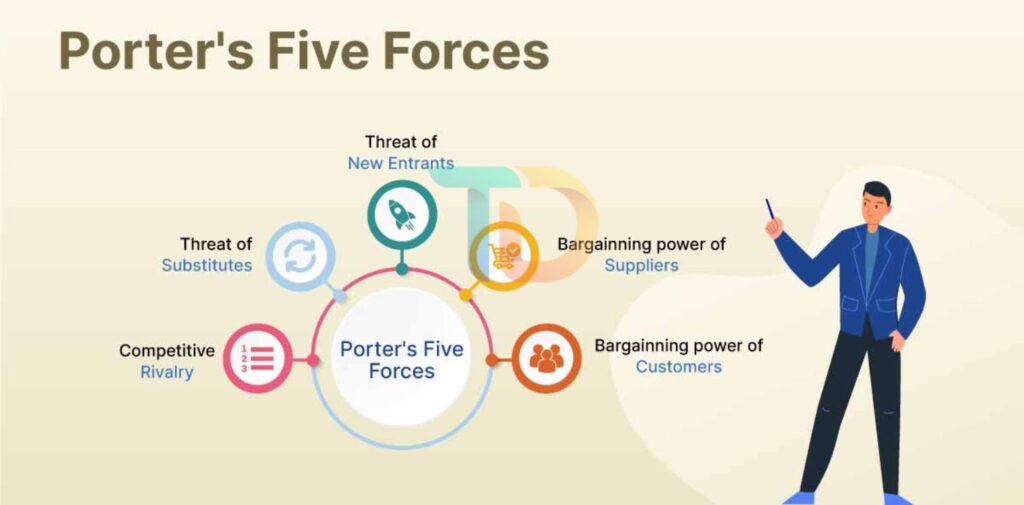
Porter’s Five Forces model focuses on five key factors that affect the competitive intensity and profitability of an industry. These forces are:
- Threat of New Entrants – How easy or difficult it is for new businesses to enter the industry.
- Bargaining Power of Suppliers – The power suppliers have in influencing prices and terms.
- Bargaining Power of Buyers – The power consumers have in driving prices and product quality.
- Threat of Substitute Products or Services – The likelihood of customers switching to alternatives.
- Industry Rivalry – The level of competition among existing businesses in the industry.
Let’s explore each of these forces in more detail and understand how they impact market competition.
Threat of New Entrants
In any market, the ease or difficulty of new businesses entering the industry plays a significant role in competition. In India, where the market is large and diverse, the threat of new entrants is often high, especially in industries like retail, technology, and e-commerce. New businesses can bring fresh ideas, competitive pricing, and innovative products that challenge existing players.
To assess this force, businesses need to consider factors such as barriers to entry, which could include things like high capital requirements, economies of scale, patents or trademarks, and government regulations. For example, the e-commerce industry in India has low entry barriers, allowing many small players to enter the market. However, the telecom industry, with its high investment costs, has higher entry barriers, making it more difficult for new competitors to emerge.
Bargaining Power of Suppliers
Suppliers play an important role in the competitive landscape of an industry. The bargaining power of suppliers refers to how much control suppliers have over the prices of inputs and the quality of materials. In India, some industries, such as the agriculture sector, are highly dependent on suppliers for raw materials, while others, like technology and manufacturing, have more flexibility in choosing suppliers.
If suppliers are few in number or if their products are unique and difficult to substitute, they have more power. On the other hand, if there are many suppliers offering similar products, businesses have more options and can negotiate better terms. For instance, in the automobile industry, car manufacturers often have a wide range of suppliers to choose from, reducing the power of individual suppliers. However, in sectors like pharmaceuticals, where raw materials are specialized, the power of suppliers can be stronger.
Bargaining Power of Buyers
The bargaining power of buyers is another crucial force in the market. This refers to how much influence consumers have on the price and quality of products or services. In India, where consumers are becoming more informed and price-sensitive, the bargaining power of buyers has increased significantly, especially in industries like retail and telecommunications.
When buyers have many alternatives to choose from, they can demand better prices, higher quality, or additional services. This is why businesses need to offer unique value propositions to retain customers. For example, in the smartphone market in India, consumers have many options at varying price points. As a result, companies need to offer competitive prices, excellent customer service, and the latest features to attract and retain customers.
Threat of Substitute Products or Services
Substitute products or services are alternatives that can replace your offering. The higher the threat of substitutes, the more competitive the market becomes. In India, industries such as transportation face significant threats from substitutes. For example, taxi services are increasingly being replaced by ride-sharing apps like Uber and Ola, which offer more convenience and competitive pricing.
When substitutes are easily available and offer similar or better value, businesses must innovate and differentiate themselves to stay ahead. For instance, the food delivery industry faces competition from home-cooked meals, local restaurants, and packaged food products. To counter this, delivery services like Swiggy and Zomato offer discounts, a wide variety of choices, and quick delivery options to remain competitive.
Industry Rivalry
Industry rivalry refers to the level of competition among existing players in the market. In India, rivalry can be intense in many industries due to the presence of both large players and small businesses. For example, the retail industry has fierce competition, with established giants like Reliance Retail and DMart competing against local stores and online platforms like Amazon and Flipkart.
The more competitors there are in the market, the more pressure businesses face to lower prices, improve products, or invest in marketing. To analyze the level of rivalry, businesses should look at factors like the number of competitors, industry growth rate, and the diversity of competitors. High rivalry can lead to price wars and lower profitability, while low rivalry may indicate a less competitive market with greater profit potential.
Conclusion
Using Porter’s Five Forces to evaluate market competition provides valuable insights into the factors influencing your industry’s competitive landscape. By analyzing the threat of new entrants, bargaining power of suppliers, bargaining power of buyers, threat of substitutes, and industry rivalry, businesses can identify opportunities, assess risks, and create strategies that align with market conditions. For businesses in India, where market dynamics are constantly changing, applying Porter’s Five Forces can help them make informed decisions and stay competitive in an ever-evolving business environment.
